

Beverly Hills architecture is a 100-year scrapbook of Southern California taste: Spanish Revival city hall towers, a pink-and-green hotel icon, Tudor estates, a storybook cottage and hillside glass boxes. The best way to read it is block by block, with someone who can tell you who built what and why. That is how we run our Beverly Hills stops: the sights come with the story behind them, so the mansions stop being a blur of hedges and gates.
This guide gives you the styles to recognize, the landmarks you can see from public streets and parks, and a simple plan for turning it into a day out.
TL;DR
- Beverly Hills was laid out as a park-like residential city, with curving tree-lined streets, big lots to the north and a different tree species planted along each street.
- The look you will see most: Spanish Revival (City Hall), Hollywood Regency glamour (the Beverly Hills Hotel), International style (the Beverly Hilton) and mid-century modern in Trousdale Estates.
- Paul R. Williams, one of the city’s key architects, shaped the Beverly Hills Hotel and the Beverly Wilshire.
- Many of the best houses sit behind gates, so a guided route past public viewpoints beats wandering alone.
- Our Celebrity Homes Tour and Private LA Tour put the city’s architecture and history in context.
Table of Contents
- Why Beverly Hills looks the way it does
- The styles to spot
- Landmarks you can see from public places
- What about the most famous house in Los Angeles?
- A short history of preservation
- Why a guided route beats a self-made map
- A simple half-day architecture plan
- Book your Beverly Hills tour
- Our take
- FAQ
- Sources
Why Beverly Hills looks the way it does
Beverly Hills did not grow by accident. Wilbur Cook’s plan created a community of private estates in a park-like setting, with gently curving, tree-lined streets, larger lots to the north and smaller parcels to the south, houses set back from the sidewalk and screened by flowering hedges, and public parks, according to The Cultural Landscape Foundation. That is why a drive here feels so different from the grid of the rest of Los Angeles.
The trees are part of the architecture too. Horticulturalist John Reeves was hired to plan the city’s plantings and is credited with the idea of giving each street its own tree species along its entire length, per the California Preservation Foundation’s walking tour guide. Tip for photographers: shoot a street looking straight down its length and let the repeating trunks do the work.
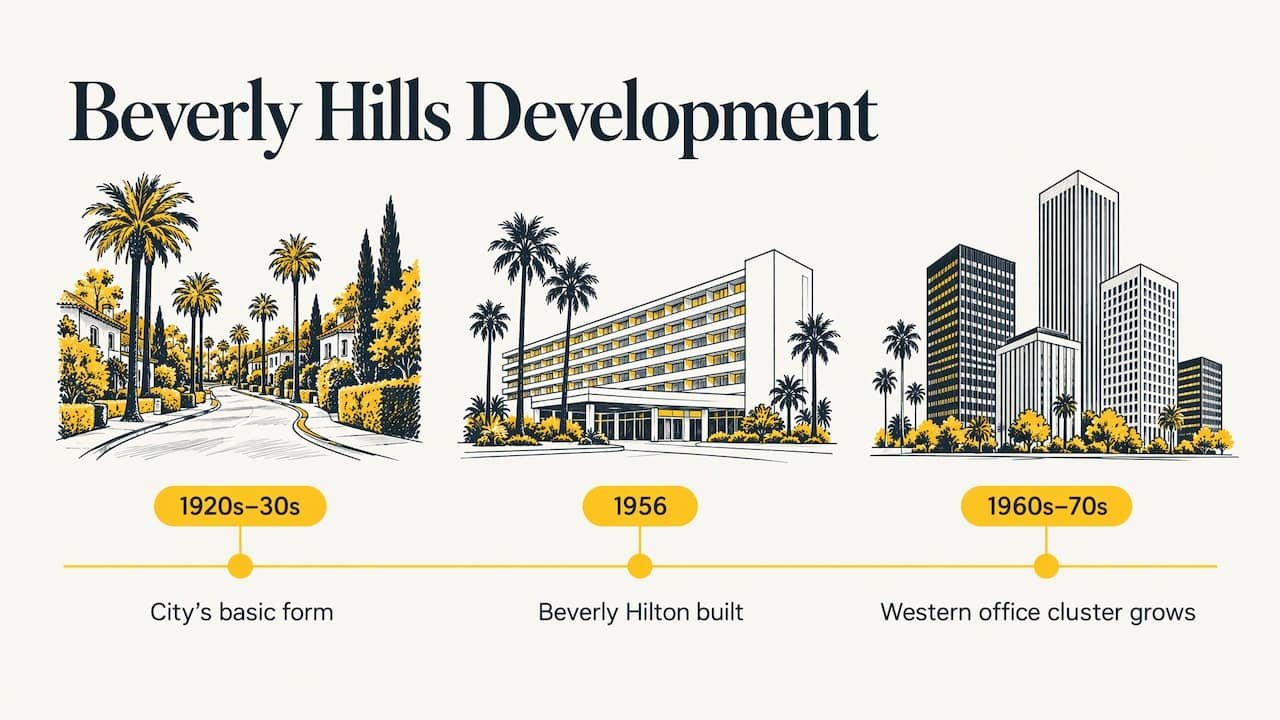
The same guide describes the 1920s and 1930s as the period that created the city’s basic form and character, through downtown commercial development and multi-family housing south of Wilshire and Santa Monica Boulevards. Later decades layered on more: the Beverly Hilton, designed by Welton Becket in the International style, went up in 1956, and in the 1960s and 70s the western end of downtown became the most densely developed office cluster outside downtown Los Angeles.
Want the longer backstory, from bean fields to Rodeo Drive? Our Beverly Hills history article covers it.
The styles to spot
You do not need an architecture degree. Learn these five looks and you can read most blocks.
- Spanish Revival. Think red tile roofs, white stucco, arches and ornamental tilework. Beverly Hills City Hall, designed by William J. Gage and Harry G. Koerner in the 1930s, is the textbook example, with a dome in blue, green and gold tile that was cleaned in 1982, per Love Beverly Hills.
- Hollywood Regency glamour. Bold color, grand entrances and resort-style details. The Beverly Hills Hotel is the icon (more below).
- Tudor Revival. Steep gables, half-timbering and stone, the storybook look of the great estates tucked into the canyons.
- International style. Clean lines, glass and steel, the commercial-modern look of the mid-1950s. The Beverly Hilton is the local landmark.
- Mid-century modern. Flat or low-pitched roofs, walls of glass and indoor-outdoor living, concentrated in the hills above the city.
Quick spotting tip: if a building looks like a Spanish village, it is probably from the 1920s or 30s. If it looks like a floating glass box on a slope, it is probably from the 1950s or later, or a new build that borrows that look.
Landmarks you can see from public places
Much of Beverly Hills is private. These stops are not, and they make a strong architectural sampler.
The Beverly Hills Hotel
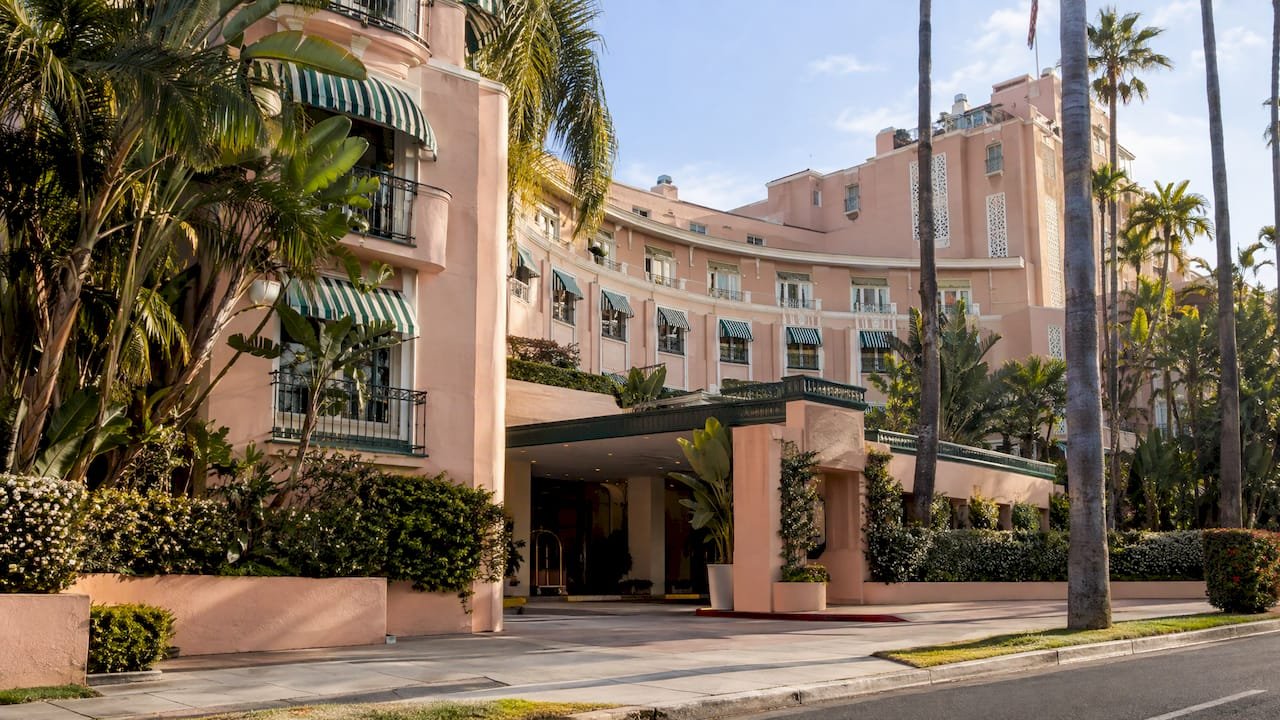
The “Pink Palace” got its signature look in the 1940s, when African American architect Paul R. Williams redesigned it. His work added the Crescent Wing, a red-carpet entrance, poolside cabanas, the Crystal Ballroom and the pink-and-green palette with script signage, according to Love Beverly Hills. If you only photograph one facade, make it this one, ideally in the warm light just before sunset. We also dig into the area’s famous lodgings in our guide to landmark hotels of the Sunset Strip.
The Beverly Wilshire
Designed by Walker and Eisen, the Beverly-Wilshire Apartment-Hotel was completed by the end of 1927 and opened on January 14, 1928. Williams returned between 1946 and 1957 to add a grand ballroom, the Copa Club and an Olympic-sized swimming pool, per the University of Washington’s PCAD database. It sits at the foot of Rodeo Drive, so it is an easy one to fold into a shopping stroll.
Beverly Hills City Hall
The Spanish Revival civic centerpiece mentioned above is worth a slow walk-around. Look up at the tiled dome, then notice how the arches and ornament pick up the same Mediterranean theme you will spot on older storefronts and apartments nearby.
Beverly Gardens Park and the Witch’s House
This ribbon of green along Santa Monica Boulevard is anchored by the 40-foot Beverly Hills Sign and the Lily Pond, described by Love Beverly Hills as the most photographed location in the city. Public art here includes Roxy Paine’s 15-foot-wide stainless-steel Erratic and Yayoi Kusama’s Hymn of Life: Tulips.
A short drive away is the Witch’s House (the Spadena House). It was built in 1921 for a silent-film studio in Culver City and moved to its Beverly Hills spot in 1934. Its drooping roof and fanciful garden give it a storybook look, per the same walking tour. It is a private home, so this is a view-from-the-sidewalk stop.
Trousdale Estates
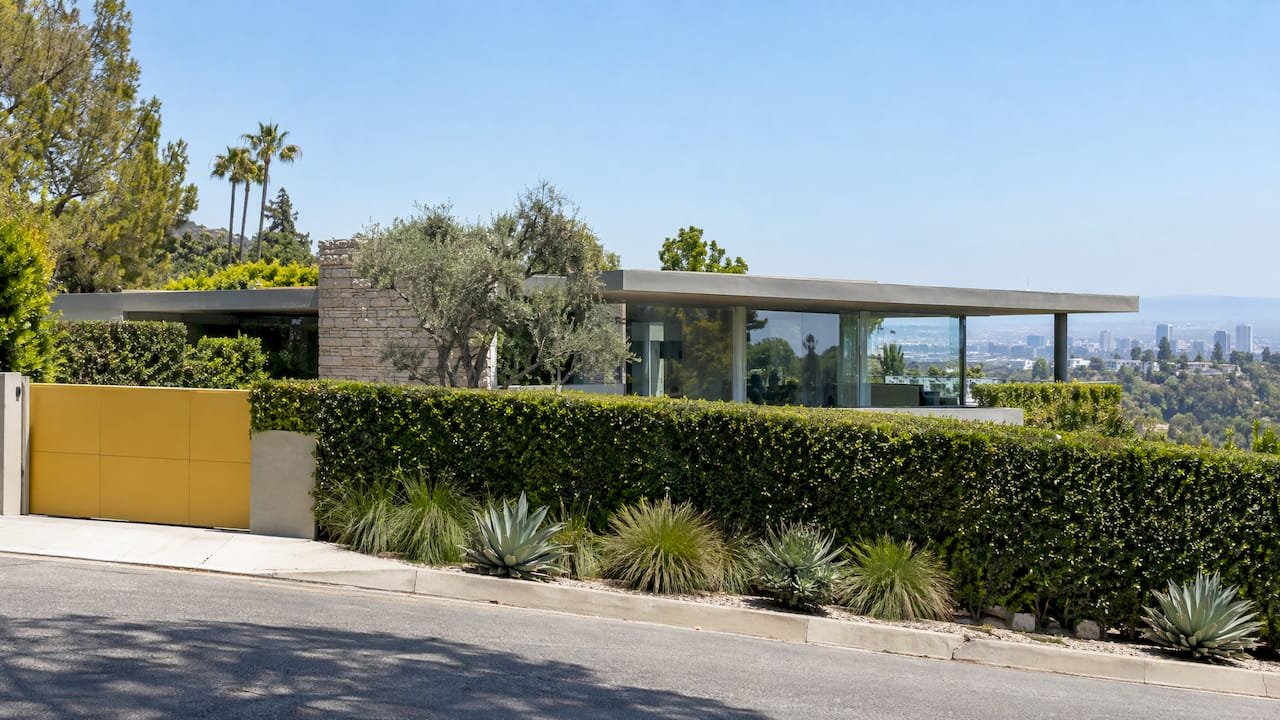
For mid-century modern, head into the hills. Trousdale Estates was developed in the 1950s by Paul Trousdale on former Doheny Ranch land and is known for mid-century homes by architects including Wallace Neff, Richard Dorman and Frank Lloyd Wright, according to Love Beverly Hills. A local broker describes the neighborhood’s 1955 plan as one that built luxury and leisure into the design from the start, per Hilton & Hyland. Expect gates, walls and hedges: you are admiring rooflines and glass from the road.
What about the most famous house in Los Angeles?
People often ask which single house is the most famous architecturally. There is no official ranking, but the name that comes up most is the Stahl House (Case Study House #22) by Pierre Koenig, at 1635 Woods Drive. It is listed on the National Register of Historic Places and open for architectural tours, according to Christie’s Real Estate’s LA styles guide. It sits in the Hollywood Hills rather than in Beverly Hills proper, but it shows where the glass-and-steel look you see in Trousdale Estates came from.
A short history of preservation
Beverly Hills lost landmarks before it protected them. After Richard Neutra’s Kronish House (1954, Sunset Boulevard) came under threat, the city council adopted a historic preservation ordinance in 2012 aiming to protect the most exceptional properties, per the Beverly Hills Register of Historic Properties. The register includes works by Frank Lloyd Wright, Richard Neutra, Greene and Greene, Paul R. Williams, Gordon Kaufmann and Wallace Neff.
For visitors, the takeaway is simple: the city treats its best buildings as heritage now, which means the street-level views you enjoy today are more likely to be around for the next visitor too.
Why a guided route beats a self-made map
Beverly Hills is easy to drive through and hard to understand. The best houses hide behind hedges. Street names repeat the tree-per-street idea, and nothing on the curb tells you that a gate belongs to a famous design. Parking near the hotels and shopping streets is its own puzzle, and you cannot photograph a rooftop from the car window while also finding the next turn.
A guide solves all three at once. You get the viewpoints, the names and the stories in order, and you can spend your attention on the view. Our tours are built around exactly that: sightseeing with exclusive stops and storytelling, so you hear how the neighborhoods and landmarks of Los Angeles came to be.
Pick the tour that fits your group
| If you are… | Look at |
|---|---|
| Curious about homes and who lived behind the gates | Celebrity Homes Tour |
| Wanting a longer day from Hollywood to the coast | 4.5-Hour & 3-Stop Hollywood to Santa Monica Tour |
| A family, couple or small group who want to set the pace | Private Tour, listed at $450 |
| A short, high-impact overview | 3-Hour & 3-Stop LA VIP Tour |
| Wanting the whole skyline from above | Helicopter tours, with the Hollywood Sign flight listed at $159 |
Thinking about a bigger Beverly Hills day? Our article on Beverly Hills tours shows what else the area has to offer beyond the mansions.
A simple half-day architecture plan
- Morning, downtown Beverly Hills. Start at City Hall for the Spanish Revival dome, then walk to Beverly Gardens Park for the Beverly Hills Sign and the public art.
- Midday, Rodeo Drive and the Beverly Wilshire. Look up at the 1927 hotel, then grab lunch nearby.
- Afternoon, the Pink Palace. Photograph the Beverly Hills Hotel’s pink-and-green entrance and palm-lined approach.
- Late afternoon, the hills. Drive or ride up toward Trousdale Estates for rooflines, glass and city views as the light turns golden.
- Optional extra. Add the Witch’s House for a storybook detour.
Photography tips: shoot wide to capture whole facades, then switch to a short telephoto for tilework and rooflines you cannot get near. A polarizer cuts glare on glass and deepens the sky behind white stucco. For more camera-friendly stops across the city, see our Instagrammable spots guide.
Book your Beverly Hills tour
If you want the architecture explained as you roll past it, our guided tours are built for that. Pick the Celebrity Homes Tour for the houses, or a private tour when you want your own pace and your own questions. You can book online or by phone through Golden Ticket LA.

Our take
Beverly Hills is a city you read with your eyes up. Anyone can drive past the gates, but what makes the place special is the story: why the streets curve, why each one has its own tree, who redesigned the pink hotel and how a 1920s dream town became a global address.
That is why we build our tours around storytelling and exclusive stops instead of a quick drive-by. Visitors tell us in their reviews what they remember is the professionalism of the guides and the way the city came alive. We think architecture is the best way into that story, because every roofline is a clue to a decade.
So bring a camera, bring the family or your favorite person, and let us do the navigating.
vincent
FAQ
What architectural styles define Beverly Hills?
The most visible are Spanish Revival, Hollywood Regency glamour, Tudor Revival, International style and mid-century modern. City Hall shows Spanish Revival, the Beverly Hilton the International style, and Trousdale Estates the mid-century look.
When was Beverly Hills built?
The 1920s and 1930s created the city’s basic form and architectural character, according to the California Preservation Foundation. Major additions followed in the 1950s, including the Beverly Hilton (1956) and Trousdale Estates.
Can you go inside the famous Beverly Hills mansions?
Most are private homes, so the usual way to enjoy them is from public streets and viewpoints. Our guided tours are designed to take you past the best of them with the history attached.
Who was Paul R. Williams?
He was an African American architect who redesigned the Beverly Hills Hotel in the 1940s and made additions to the Beverly Wilshire between 1946 and 1957, per Love Beverly Hills and PCAD. His work appears on the city’s historic register.
Sources
- Beverly Hills | The Cultural Landscape Foundation
- California Preservation Foundation, Beverly Hills walking tour
- 10 Architectural Masterpieces in Beverly Hills | Love Beverly Hills
- Art + Culture Walking Tour | Love Beverly Hills
- PCAD: Beverly-Wilshire Apartment Hotel
- Sprawling Trousdale Estates | Hilton & Hyland
- LA Luxury Architectural Styles Guide | Christie’s Real Estate
- Beverly Hills Register of Historic Properties